





Guest article written by Peter Barrios-Lech Associate Professor of Classics, College of Liberal Arts, University of Massachusetts.
I. An All-Too Direct Question About The Indirect Question.
One evening, about an hour before the start of my night-time Roman comedy seminar, three of us – two graduate students and I – met in my office to undertake our weekly rite of sight reading from Plautus. The goal was to better understand Plautine Latin, which, as I would soon learn, is not always as simple as it appears.
So, that night, the Pseudolus, with its typical Plautine plot. A young man has fallen in love with a prostitute. He doesn’t have the money to purchase her from her pimp. So he demands that his slave get the needed money, using that cunning that gave him his name, Pseudolus, (ψευ-dolos, “Monsieur Flim-Flam”).
Here are the first lines of that play, first produced in 191 B.C., in front of the temple to the Great Mother, Magna Mater. The temple steps are packed with seated audience members; there is standing room only for the premiere of the latest comedy-opera from the now legendary sixty or so year old Umbrian poet. Sit yourself down among these spectators to watch the opening tableau. Do you see the young man, dressed in the elegant himation? The youth grasps two wooden leaves, each covered on one side with wax, inscribed with a missive from his enslaved girlfriend. He sobs: Eheu!Eheu! The audience laughs as Pseudolus enters from the wing, scurrying behind, his grotesque mask, with the flanged lips of its mouth, twisted into a mocking smile. From that aperture, the actor playing Pseudolus booms forth the famous opening lines one morning – this morning – on the Palatine. His mockingly shrill voice contrasts with audible sobs of the youth, provoking further titters from the audience:
(1.)
Ps. Licet me id scire quid sit? nam tu me antidhac
supremum habuisti comitem consiliis tuis.
Cal. Idem animus nunc est. Ps. Face me certum quid tibist;
iuvabo aut re aut opera aut consilio bono. (Pl. Ps. 16–19, Leo)
Ps. Can I know what the matter is?? After all, I’ve always been
your colonel, captain, consigliere in chief (mock-salutes).
Cal. (glances between sobs) You continue to be. Ps. Then bring me into the loop:
(coolly) I’ll help with cash, service-on-demand, or good advice. (Pl. Ps. 16–19, Leo)
Right now, we do not focus on questions of staging, on the play as a document of mid-Republican Roman culture; on plot and characterization – those questions we’ll broach in class, later on. Right now, our aim is to come to grips with the language.
À propos, one student asks, “why does Pseudolus use the subjunctive here (she points to the first line, bolded), but not also here (third line, also bolded)?
I hesitate; compliment the student: this is a sharp observation. I have no good answer. Maybe meter is at stake in the second instance (face me certum quid tibist); maybe at this period of Latin there was more variation of mood in the indirect question clause. We head to class, and I resolve someday to find a better answer.
II. Revisiting The Golden Rule On The Indirect Question.
Everyone knows the rule about the indirect question in Classical Latin. Here are some well-known versions of it in grammars used across American college classrooms:
(2.)
“An Indirect Question takes its verb in the Subjunctive” (Allen and Greenough, §574)
(3.)
“[t]he Dependent Interrogative is always in the Subjunctive” (Gildersleeve and Lodge § 467)
So, according to the rule, you want to say nescio cur legam hanc symbolam “I don’t know why I’m reading this essay,” not nescio cur lego hanc symbolam.
In German gymnasia,or high schools, the subjunctive in that dependent clause was required, “[a]ccording to the rule in Classical Latin – a rule which teachers stamped into the memory of their students, [that] the subjunctive stands in all subordinate interrogative clauses” (Wackernagel, Lectures on Syntax, 1929, I, 242).
So was the rule stamped into my memory, and that of many other Latin students. But now, in light of a student’s keen observation, I wanted to revisit this Golden Age Latin precept.
III. Getting The Data
How often was the indicative used in Latin indirect question clauses? More often in certain authors? Genres? Maybe it was just an “Early Latin” thing? Would gathering data and, isolating patterns from it help to understand the variation we saw?
Ideally, I would have gathered all the indirect questions in Early and Classical Latin. Realistically, I could probably cover the subject just for Early Latin. I found a pocket of time unclaimed by other obligations – my train ride back home – during which I could read. And so, Plautus, Ennius, Cato, Pacuvius, Terence, Accius, Lucilius, and other hoary Early Latin authors became my travelling companions for about a year’s worth of MBTA train rides, Boston to Providence, back home from work.
I began with – who else? – Plautus, collecting on a spreadsheet any indirect question I found, tagging each token – each individual instance – with information about mood used, the “head” verb (for instance scio quid agas, vide num venerit, and so on); subordinator (quid and num in the examples just mentioned); speaker and addressee, and more. I probably spent equal amounts of time staring at the Latin, as I did at my Excel spreadsheets.
But it was worth it, because, to be honest, this project was motivated only in part by my desire to get the answer; it was also at least in equal measure driven by the desire to revisit some of my favorite authors – the fellow commuters I mentioned above.
Once they had surrendered the data to me, I started looking through it. What did I find?
IV. Wilhelm Studemund
Brief digression. I actually am not the first person (crazy enough?) to try this. 135 years ago, in the hotbed of Latin studies that was late 19th C. Strassburg, Germany, Wilhelm Studemund had gained great fame by deciphering a palimpsest that was thought nearly illegible, the famous Ambrosianus (MS A), representing our earliest (5th C CE) witness to Plautus, whose comedies had been copied down in M(anu)S(criptus) A(mbrosianus/a) with beautiful Rustic Capitals. Studemund had a nose for unearthing the text hidden under or between the lines of palimpsests. For instance, he had also discovered the letters of Fronto latent for centuries underneath the records, the Acta, of the Council of Calchedon. Anyway, long before Studemund had gotten to it, the Plautus manuscript, “A” had been written over with a commentary on the Book of Kings. Then, in the 19th C., a certain Cardinal Angelo Mai had used a chemical to try to recover the underlying text of Plautus, but in effect did much damage to it. Studemund, in later deciphering the damaged text, ended up losing his sight (the whole story can be found in Texts and Transmissions, pp. 302–307).
As he worked on his transcription, Studemund was also overseeing a veritable hive of activity in the field of Early Latin. His graduate students published their findings in a work titled Studemunds Studien, or “Studemund’s Studies”; they can be read here and here (the latter a searchable version only). (That’s the title, but within the volume, each individual opusculum is duly attributed to its author) They are examples of a tradition of philology that continues today, with the difference that some of Studemund’s students wrote the monographs in Latin. (Not a few classicists, however, have begun reviving this time-honored tradition, that of publishing serious scholarship in Latin, see here and here; not to mention the many contributions to this very site.)
Among the Studien, you will find Paulus Richter’s 254-page Latin monograph on interjections – everything you wanted to know about heus, eheu, aha, and more.Among the Studien, you’ll also find Eduard Becker’s monograph on the Early Latin indirect question – written in a lucid periodic style. Working my way through it, I soon realized that Becker had read everything. From the extant 26 Roman comedies, and the fragments of lost Early Latin drama, to the fragments from Lucilius’ lost Satires and Early Latin inscriptions, all of this in the time before PHI, JSTOR, Google, and super-fast Inter-Library Loan. Becker’s work has been so fundamental, that it has informed everything written on the indirect question since: his principal findings are basically those you’ll find in the standard reference grammars. No-one has really superseded Becker, and had I known about him, I might not have even embarked on what now, having read his monograph, seemed like a foolhardy mission.
V. The Becker Rules
There are cases where the indicative is normal in indirect questions. Here are several, elucidated by Becker:
INDICATIVE IS NORMAL IN THE INDIRECT QUESTION CLAUSE WHEN
The main-clause verb is a verb of ‘saying’ and it is imperative in mood. Typical are phrases like obsecro hercle loquere, quis is est (Pl. Bac. 553), “tell me, please, where he is!” The indicative in such indirect questions is normal because, as Becker explains, loquere adds emphasis, but is hardly necessary to the syntax; that is, you could express the same urgent question without loquere. And so, loquere and related forms, like dic, cedo, and narra,when introducing indirect clauses, function more like emphatic particles than ‘real’ main-clause verbs.
The exceptions are numerous enough that we should probably speak of a tendency rather than a rule. Thus, of all the instances of such questions in Plautus (those like obsecro hercle loquere, quis is est), 23% (36 out of the total 158 relevant instances) have the subjunctive; and, in Terence, 20% (11 out of 54) have the subjunctive where we might have expected the indicative. Here is an example: loquere porro, quid sit actum (Pl. Mer. 199): “tell me, what happened.”
What is the difference between loquere porro, quid sit actum and obsecro hercle loquere, quis is est? I personally don’t see any. Probably, back when these lines were first uttered aloud to a Roman audience, each had a distinctive intonational contour: maybe the second was pronounced as two intonational units (Tell me: who is he?) and the first as one (tell me what happened). But maybe, in another early performance of this same play, another actor pronounced the questions with a completely different intonation.
Exclaiming something. Exclamations and questions draw from the same set of ‘question’ words. This is as true in English (“what wonderful weather!” and “what is the weather like today?”) as it is for Latin. Here’s a flabbergasted woman asking her husband if he understands the consequences of his excessive punishment of their son: non vides quantum mali ex <ea> re excites? (Ter. Hau. 1013), “don’t you see how much trouble you’re causing because of it?”. And here is a tricky slave, pointing out that his own intelligence supersedes that of his notional better: o Phaedria, incredibile[st] quantum erum ante eo sapientia (Ter. Ph. 247), “O Phaedria, it’s incredible how far I excel master in wisdom!”
The second is not a question at all: it is an exclamation. While questions seek answers (as the woman’s does, in the first example from Terence), exclamations present some proposition (“how smart I am!”) as exceeding expectations, and thus as worthy of note. No wonder, then, as Becker reasoned, indirect questions like the tricky slave’s don’t take the indicative: for they are not questions of any kind, at all.
To repeat: exclamations ask us to notice something that is, well, note-worthy. Sometimes, in Early Latin plays, the character asks us or someone directly to note something surprising, as, for instance, in the following, about the high cost of living in late 3rd C. BCE Rome: uiden ut annonast grauis? (Pl. St. 1070), “do you see how expensive the cost of living is?” Again, no question is being asked here. Rather the speaker – a slave in this play – asks us to consider what is – for him – an upsetting proposition. You don’t even need the viden (or vide): ut annonast gravis! would also have done the trick. It turns out that anytime an exclamation is introduced first by a call to notice – viden or vide – the subordinate clause always has the indicative.
There are other tendencies I could give. For instance, when the verb dico heads an ut clause, as in dico hercle ego quoque ut facturus sum (Pl. As. 376), an indicative always appears in the ut clause. I’m not sure why this is. Maybe such phrases are calques, or loan translations, of the Greek indirect question, which doesn’t as a rule, take any particular mood, and is introduced with ὡς (equivalent to Latin ut when it means “how”). At any rate, the two tendencies I just isolated above are the most clear-cut.
VI. The Difference Between Plautus And Terence
Plautus and Terence are about as different as two playwrights working in the same genre could be. If Plautus is Robin Williams, then Terence is Jerry Seinfeld. If Plautus is Queen, then Terence is Radiohead. If Plautus were alive today, he would have directed Animal House; if Terence were, we would praise his Sideways. The differences run deeper than the characterizations and the moods created – they affect even the language the playwrights use.
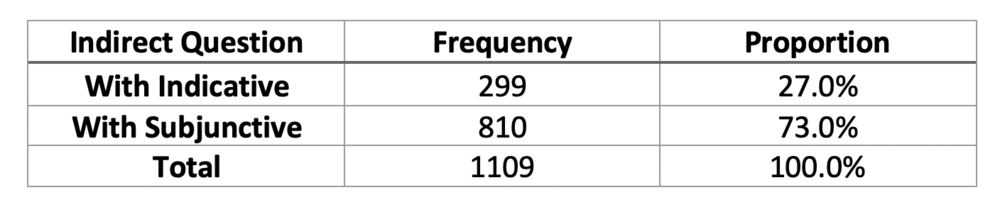
For instance, if you glance at the tables below, you’ll see that Plautus uses indirect questions with the indicative more often – significantly more – than Terence.
Here’s the summary for Plautus:
Now check out Terence:
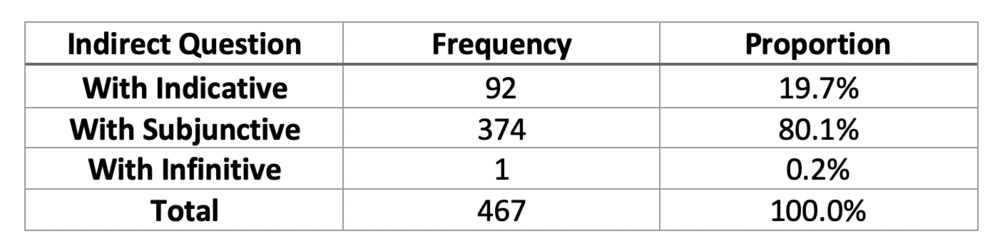
So you see that of all the indirect questions in Plautus, 27.0% have the indicative; fewer – 19.7% – have the indicative in Terence. Why is that?
One idea is that Terence’s plays represent a later stage in the language – he wrote some forty years after Plautus was active – so that, in the later playwright, we see an advance towards the norm of Classical Latin: subjunctive in the subordinate question clause.
Another idea rests on Terence’s cultivation of a supple, elegant style: Cicero and Caesar were such avid readers of Terence that they wrote epigrams on Terence’s lectus “carefully chosen” (Cicero), purus “grammatically clean” (Caesar) sermo (“grammatically clean”, yes, he says, but not funny at all). Is the high incidence of the subjunctive, then, a sign of Terence’s careful writing?
To check this, I decided to compare my corpus of informal Early Latin (mostly comedy, but also Lucilius’ satires); against the data pulled from stylistically elevated Latin – including the fragments of tragedy and Roman historical plays, the praetextae – about 1700 verses or parts of verses in Otto Ribbeck’s third edition of the fragments, in addition to epic, historians (none of whose works exist in their entire), and other prose writers (mostly Cato).
In serious genres, the indicative in the subordinate clause occurs less frequently than in light genres. The difference between the two proportions – 14.3% for serious writing and 25.1% for light genres – is significant. What this meant to me was that indicatives in subordinate question clauses were probably part of the informal, colloquial register of the language.
VII. The Big Takeaway
Recent research for Classical Latin has shown that the indicative used in subordinate indirect question clauses was a phenomenon of a more relaxed style of speech. Even such a grammatical purist as Caesar, when writing a letter, lets such an indicative slip in (Att.9.7c.1.5–6). Such must have been the case in the Early Latin period, too: the indicative abounded in less careful speech – the kind of speech of the quickly dashed off note; of a casual conversation; of a comic dialogue. In a word, there’s a basic continuity – at least in indirect question usage – between the Early Latin and Classical Latin period.
That indirect question-clauses containing indicatives mark an informal style goes together with other findings on Roman comedy: one study, for instance, shows that contractions like currendum’st (< currendum est Ps. 331) and molestu’s (< molestus es, Mer. 767), are characteristic of informal speech, too. In this respect, also, Roman comedy imitates the conversational style, just as this blogpost does, with its contractions, occasional sentence fragments, and borrowings from the lexicon of informal speech, like “interjectional ‘well’”.